Why Retail Media is the Most Critical Strategic Hedge for Modern Brands
Beyond Performance: Orchestrating Data and Narrative to Capture the Modern Value-Seeking Consumer
The retail landscape is currently defined by a profound paradox: while the U.S. economy remains resilient with robust consumer spending, a widening wealth gap and persistent inflation have created a bifurcated shopper. High-income households are buoyed by a $12 trillion wealth gain, while lower-income cohorts are feeling an acute affordability crisis. For senior leaders, the traditional playbook of broad reach and high-volume promotion is failing to hold the line.
The new reality is that Retail Media Networks (RMNs) are no longer isolated digital ad buckets they have evolved into a high-margin engine of growth that integrates directly with a brand’s value proposition. Retailers are moving away from simple “sponsored search” to full-funnel storytelling vehicles that provide a critical hedge against margin compression and rising customer acquisition costs.
What is Happening: The Evolution from Performance to Storytelling
Historically, retail media (RMN 1.0) was a digital “shelf-shifter.” It was a faceless, transactional experience where brands paid for “sponsored search” to appear at the top of a results list. The goal was purely performant: driving a direct, measurable conversion at the exact moment a consumer typed in a keyword.
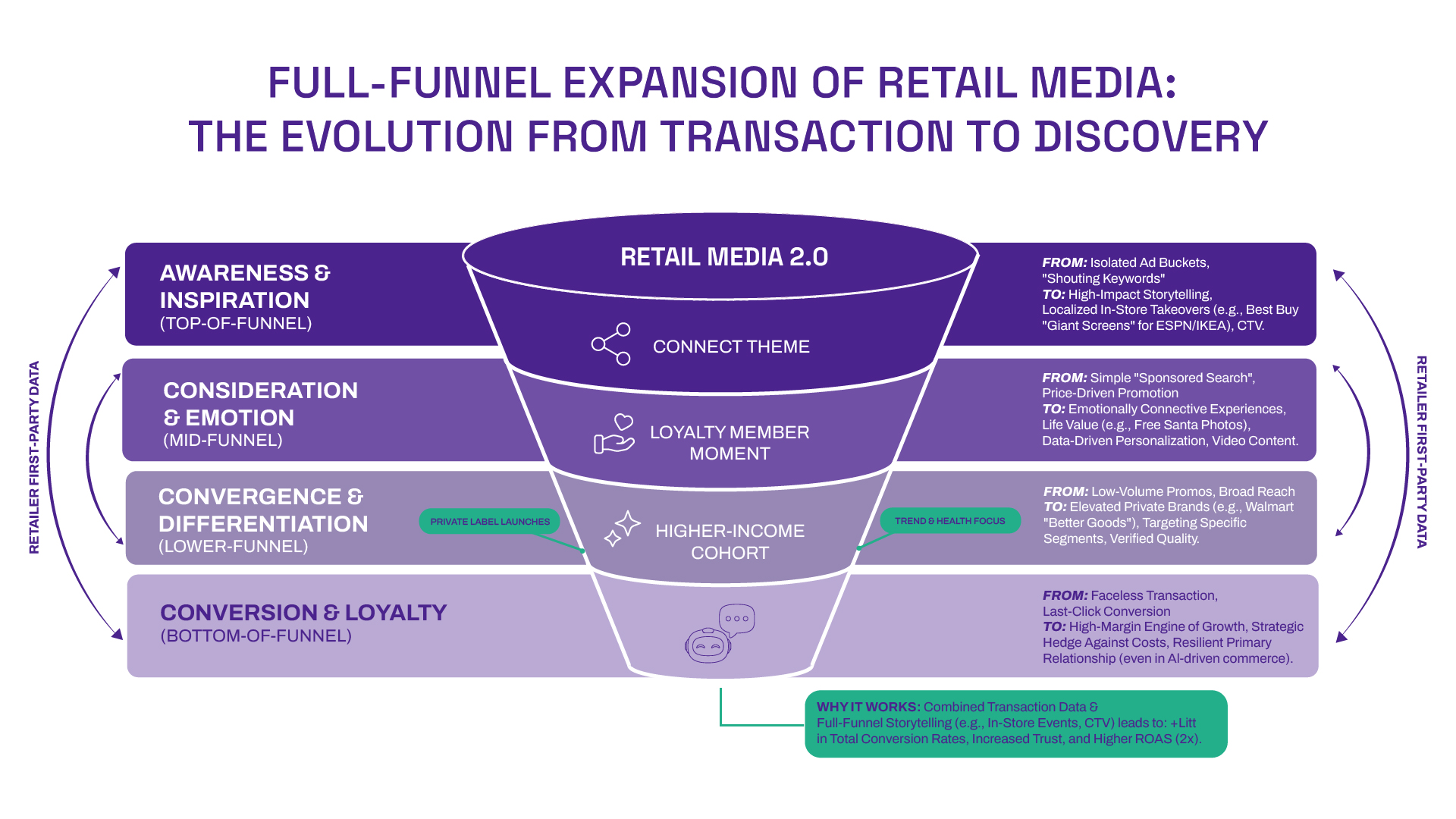
We are witnessing a “full-funnel” expansion of retail media (RMN 2.0). Leading retailers are no longer content with being the “lower-funnel conversion point”; they are turning their physical and digital assets into a canvas for brand discovery.
Retailers are now becoming “treasure maps for the treasure hunt,” using their assets to inspire consumers long before the final click. This “full-funnel” approach covers the entire journey:
- Top-of-Funnel (Awareness & Inspiration): Retailers are turning physical stores into immersive “canvases”. For example, Best Buy views its 1,000 stores as a “giant screen,” allowing partners like ESPN or IKEA to deliver high-impact storytelling to shoppers in the physical world.
- Mid-Funnel (Consideration & Emotion): Instead of just selling an item, retailers create “emotionally connective” experiences. Nordstrom partnered with Shutterfly to offer free Santa photos to loyalty members, using retail media to add value to a customer’s life through human memory rather than just a product listing.
- The Convergence of Private Labels and Media: Retailers are leveraging their media networks to launch elevated private brands that target specific lifestyle segments. Walmart used its scale to launch Better Goods, a lifestyle brand built on pillars like plant-based and “made-without” ingredients, specifically designed to attract higher-income cohorts who prioritize trends and health over the lowest price point.
- Omnichannel Loyalty: By moving discovery upstream, retailers ensure that even when a customer is watching a review on YouTube or asking an AI agent for a recommendation, the brand remains in the “consideration set” because of the trust established through the retail network.
Why it is Happening Now: The Convergence of Trust and Precision
Three specific forces are driving this shift:
- Economic Bifurcation: With real income growth for lower-income households stagnating at 0.7%, consumers are ruthlessly seeking value. However, “value” no longer just means the lowest price; it means quality and relevance that makes a shopper “stand up a little bit straighter”.
- The “Interest Media” Shift: Traditional social media is being replaced by interest media, where algorithms prioritize relevance over follower counts. Retailers who own transaction-level data on what people actually buy have the ultimate advantage in feeding these algorithms.
- Monetizing the “Gold Mine”: Retailers sit on data that is more specific, personal, and actionable than demographic data. By tying up to 93% of transaction data back to individuals, RMNs are delivering up to a 2x Return on Ad Spend (ROAS) compared to traditional platforms.
Why it Matters for Senior Leaders: Margin, Moats, and Mastery
For executives, the strategic implications of mastering retail media are existential:
- Differentiating in an AI-Native World: As “Agentic Commerce” takes hold, where AI assistants independently research and buy products, brands must have unique, exclusive narratives and product attributes that can’t be purely price-shopped.
- Retail Media as a Profit Shield: While the first few years of e-commerce investment are often dilutive to the P&L, retail media provides the high-margin offset. It allows retailers to monetize their 1st-party data, turning a website from a cost center into a profit generator.
- Resilience Against Disintermediation: As search shifts to Large Language Models (LLMs), there is a risk that consumers will never visit a retailer’s site again. By integrating media with loyalty programs, retailers ensure they are the “treasure map for the treasure hunt,” maintaining the primary relationship with the consumer.
Strategic Takeaways
- Stop Measuring Just ROAS: Traditional ROAS masks inefficiency. Shift metrics to focus on incrementality and marginal return. If a media partner isn’t asking for your margins to calculate true ROI, they aren’t asking the right questions.
- Bridge the Data/Creative Silo: The greatest mistake of the last 20 years was separating media and creative departments. For retail media to work, high-volume organic social content must feed directly into performance-selling engines.
- Invest in “Always Forward” Culture: Retailers have a “Tuesday problem”, Monday’s great ideas often die in Tuesday’s operational firefighting. Build a culture that prioritizes long-term brand health over the next quarter’s noise.
How we can help? Check out MJV’s strategic offerings
Business Strategy Sprint to redefine your retail media approach.
Full-Funnel Design: Mapping out a “treasure map” strategy that covers awareness (Top-of-Funnel) through to loyalty (Bottom-of-Funnel).
Design & Experience pillar to bridge the gap between physical and digital assets.
Omnichannel Loyalty Integration: Designing seamless journeys where discovery starts on social media/AI and ends with a trusted transaction within the retail network.
MJV’s Extended teams can unlock:
Agentic Commerce Preparedness: Engineering data architectures so that brand narratives are discoverable by AI agents and LLMs.
Agile Transformation: Implementing agile “squads” to bridge the silo between data and creative departments, ensuring high-volume content feeds performance engines.
Let’s start a conversation about your retail strategy.
Closing Perspective: Human is the New Luxury
As AI becomes “ordinary”, the real differentiator for brands will be human connection. AI should handle operational work such as inventory monitoring and campaign optimization so that teams can focus on what technology cannot replicate: trust, creativity, and meaningful engagement.
The retailers that will lead the next decade will treat retail media not simply as an advertising channel, but as a strategic platform for building relationships with customers. In a world shaped by automation and constant change, the brands that succeed will be those that earn trust through consistent value, transparency, and genuine human experiences.
This is just one of the key themes highlighted at NRF 2026, the world’s largest retail and consumer goods event. Our team has produced a comprehensive report featuring all the trends already shaping the industry. Access the full report here.